
Can You Paint Indoors During a Minnesota Winter?
Dry furnace air and sealed windows change how interior paint behaves. Here's what to plan for.
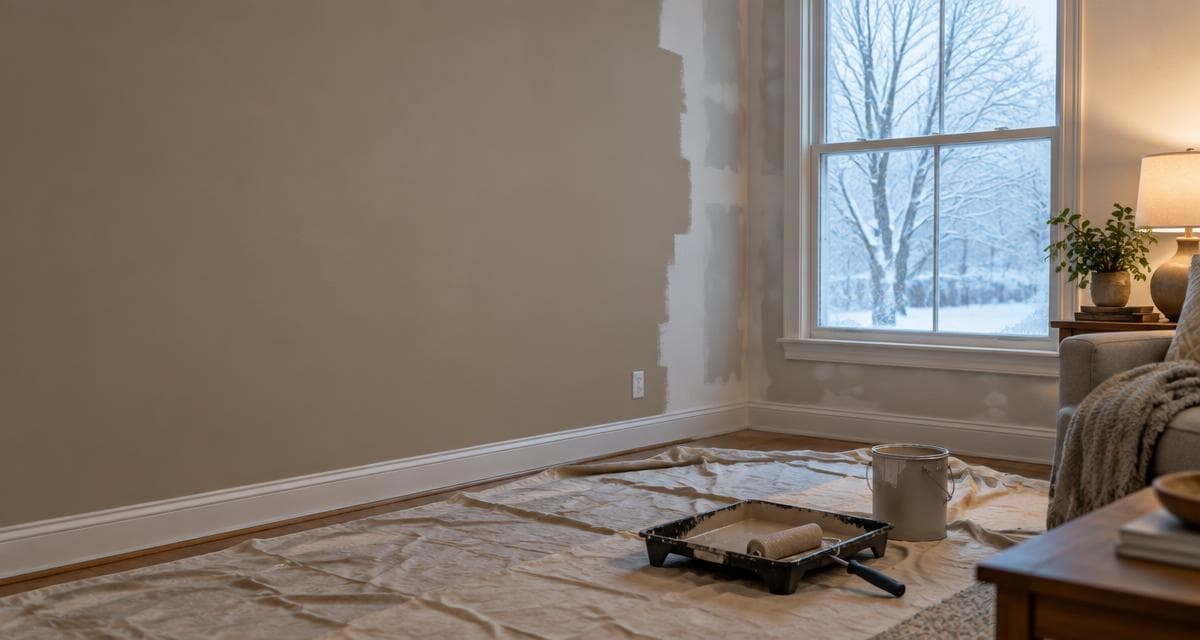
Yes, and it is one of the better times to do it. The question homeowners in Mora, Cambridge, Princeton, and Elk River actually mean is a different one: what changes when you cannot crack a window and the furnace has been running for weeks? Interior painting in a Minnesota winter works fine, but the conditions inside the house are genuinely different from June, and the crew that ignores that gets a different finish than the one that plans for it.
The Two Things Winter Actually Changes
Everything else about interior painting stays the same. Winter alters exactly two variables, and both come from the same source: your heating system.
The air gets dry. Cold outdoor air holds very little moisture. Once it comes inside and gets heated, relative humidity drops hard. That is why your skin cracks and your doors shrink in January.
The windows stay shut. Air exchange in a sealed, heated Minnesota home is limited, so whatever goes into the air stays in the air longer than it would with the windows open.
Neither is a reason to wait for spring. Both are reasons to make a couple of specific choices.
Why Dry Air Changes How Paint Behaves
Most homeowners assume dry air is good for painting because paint dries faster. It does dry faster. That is the problem.
Latex paint needs enough open time for the wet edge to stay workable while you roll into it. When humidity is very low, the surface skins over faster than the roller can keep up, and you end up with lap marks, visible roller stops, brush drag, and poor flow-out around trim and cut lines. On a large wall in a bright room, those marks are obvious once the light rakes across them.
The fixes are practical and they are mostly about technique:
- Work in smaller sections so the wet edge never has time to set.
- Keep a consistent room temperature rather than letting the thermostat swing overnight.
- Avoid blasting the furnace fan directly at a freshly coated wall, which accelerates surface drying exactly where you do not want it.
- Check the product's minimum application temperature, because most interior latex products specify one and an unheated room can fall below it.
Dry winter air also carries more static, which pulls dust onto wet surfaces. Clean prep matters more in February than in July.
The Humidifier Question
Plenty of Minnesota homes run a humidifier all winter, and it is reasonable to ask whether bumping it up helps the paint. Be careful here.
The University of Minnesota Extension notes that in cold weather, indoor relative humidity needs to stay low to prevent condensation and structural damage, and that peeling or blistering paint is itself a classic symptom of excess indoor moisture. The Minnesota Department of Health recommends keeping indoor relative humidity between 20 and 40 percent in winter.
So the answer is no, do not crank the humidifier to help the paint. If frost or condensation is forming on your windows, the humidity is already too high, and you have a bigger problem than lap marks. Modest, steady humidity within that recommended band is the target.
Ventilation and Why Low-VOC Matters More in Winter
This is where the sealed-window issue becomes a real consideration rather than a theoretical one.
Volatile organic compounds are released as gases from paint during application and drying. According to the U.S. Environmental Protection Agency, VOC concentrations are consistently higher indoors than outdoors, and elevated levels can persist well after the activity is finished. In July, opening a window solves most of that. In January, you cannot.
That is why product choice carries more weight in winter than in summer. Low-VOC and zero-VOC interior paints have improved substantially. The performance concerns that dogged early formulations, thin coverage and poor washability, are largely behind us in the premium lines. Sherwin-Williams Harmony is a zero-VOC acrylic latex with GREENGUARD Gold certification, and we use Sherwin-Williams coatings exclusively on every Minnesota home we work in.
One point worth understanding: a low-VOC label is not the same as odorless or emission-free. EPA notes that VOC labeling programs vary in what they measure, and some are based on outdoor air regulations rather than indoor emissions. Low-VOC is a meaningful improvement, not a substitute for ventilation.
Practical steps in a sealed house:
- Run bathroom and kitchen exhaust fans during and after the work.
- Keep interior doors open so the HVAC system circulates rather than concentrating air in one room.
- Crack a window briefly in the room being painted if the weather allows, even for short stretches.
- Choose sleeping arrangements so nobody spends the night in a freshly painted bedroom.
Winter Is Genuinely Good Timing
Setting the technical points aside, there are real advantages to booking interior work in the cold months. Nobody is using the deck or the yard, so an indoor project does not compete with anything. Kitchens and cabinet refinishing projects fit naturally into a season when the house is the center of life anyway. And contractor schedules open up once exterior season ends, which usually means more flexibility on timing.
It is worth saying plainly that this is a different argument from the one for fall. Our post on why fall is the best time to start interior painting in Minnesota makes the case for getting ahead of the season. Winter is about how the work is done once you are already inside with the windows closed.
Planning a Winter Project
Prep looks much the same as any other season, with a little extra attention to dust control and to keeping the heat steady rather than cycling. Our interior painting preparation checklist covers the rest.
If you are weighing a winter interior project anywhere in East Central Minnesota or the Twin Cities, our interior painting crews work through the cold months and will talk you through product selection, ventilation, and scheduling before anything gets opened. If your home has conditions that make waiting the better call, we will tell you that instead.
Trinity Painting & Renewal
Contact Number: (763) 200-4121
Email: dustin@trinitypaintingmn.com
Address: 403 Cardinal Street, Mora, MN 55051
Serving Mora, Pine City, Cambridge, Princeton, North Branch, Elk River, and the Twin Cities metro.
Ready to Schedule Your Winter Project?
Get a free, detailed estimate for your interior painting project, with no surprises along the way.